



3.1 The people-centred access to justice approach
‘With the understanding that only 20 per cent use the formal courts for resolution of their disputes, I asked myself, “If I become Chief justice, whose chief justice will I be? For the 20 per cent?” I wanted to be everybody’s Chief Justice including the 80 per cent who settle their disputes elsewhere.’
Chief Justice Martha Koome22
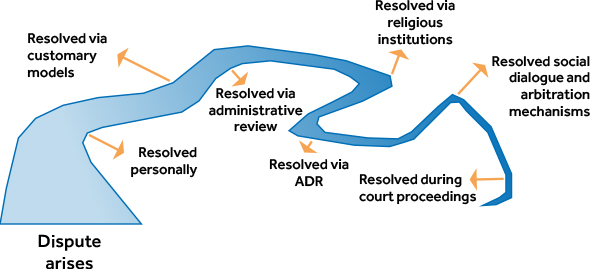
The statistics the Chief Justice was referring to are captured in the Justice Needs and Satisfaction Survey that was conducted in 2018 to map out the demand and supply of justice services as experienced by Kenyans. The survey revealed that only about 20 per cent of justice seekers had access to the formal justice system.23 These statistics have been captured elsewhere in the metaphor, ‘River of Justice’,24 which depicts the paths disputes in Kenya take. The river is in stages with the first stage being the point where the dispute arises. This is the widest point as most disputes are settled there either personally or via family and/or kinship ties. With every subsequent stage, the river gets narrower and by the time it gets to the formal courts, it has narrowed significantly (see Figure 3.1).
Figure 3.1. Framing the alternative justice systems (AJS) discussion:
the ‘river of justice’
It was the view of the Chief Justice that all justice providers, formal and informal, be they chiefs, imams, pastors or village elders, among others, must be recognised as being part of the justice system. She was keen to bring on board the simplicity of the process of experiencing justice as a key consideration in the development of the vision. The people-centred justice approach adapted by STAJ is therefore based on the acknowledgement of citizens’ expectation of the quality of justice that intrinsically serves their best interest. This ‘social’ concept seeks to not only expand, but also to accelerate access to justice from the standpoint of the citizenry in a holistic manner, with people placed at the centre of all justice interventions to facilitate justice outcomes that make sense to consumers of justice in Kenya.
Entrenching a people-centred access to justice strategy is therefore, the judiciary’s contribution to the creation of a just social order, promoting peaceful co-existence in communities and the country.
The STAJ vision highlights various features captured in the Constitution of Kenya that demonstrate its quest for social transformation and people-centeredness (see Table 3.1).
To this end, the Constitution of Kenya, 2010, provides a framework that supports people-centred responsive structures for the enhancement of public welfare and a just society.
The STAJ vision further recognised that it is through the development of social justice jurisprudence sensitive to the Kenyan social and economic context that the judiciary can contribute to the realisation of the transformative vision of the Constitution of Kenya, 2010. To achieve this, the STAJ blueprint, like its predecessors, the JTF and SJT, recognised the need to strengthen internal structures, including equipping the workforce to deliver on its mandate appropriately within the dictates of Kenya’s social and economic context.
3.2 The guiding principles for a people-centred access to justice blueprint
The STJ blueprint is anchored on five principles, as follows. 25
- Accessibility and efficiency. A justice system that is available and reachable to all members of the society regardless of gender, socio-economic status, race, ability or any other characteristic, and where all matters are resolved expeditiously.
- Transparency and accountability. A justice system that is transparent and trustworthy.
- Inclusiveness and shared leadership. A justice system that involves diverse perspectives and fosters collaboration in decision-making processes.
- Co-operative dialogue. A justice system that fosters collaboration, robust communication and inclusivity in policy-making processes.
- Social justice. A justice system that guarantees access to justice for all, regardless of socio-economic status, gender, ability or any other characteristic, and availability of legal assistance and aid.
Sustaining Development Goal 16(3) popularises the notion of people-centred justice by calling to attention the place of people as champions and beneficiaries of justice outcomes. STAJ is therefore conceptualised and is designed to be implemented through processes that use different platforms to access justice and allow people to make informed choices of the platforms to access justice. The intended outcomes of the vision are:
- strong institutions
- inspired workforce
- strong financial mechanisms
- deepened partnerships
- enhanced public trust.
The launch of the STAJ vision took place on the 100th day of the term of the Chief Justice, Martha Koome. This was an event that provided a platform for the Chief Justice to announce her vision to the institution and the public. In the spirit of inclusivity and public participation, the event was broadcast live on national television as a way of ensuring the entire nation was carried along in this new phase of judiciary transformation. The choice of invited guests was deliberate and included representatives of all justice sector institutions under the auspices of the National Council on the Administration of Justice (NCAJ). The uniqueness of the NCAJ model is that it provides a one-stop-shop for policy decision-making on administration of justice matters, as a way of promoting harmony in the dispensation of justice in Kenya. Its membership is drawn from state and non-state actors in Kenya and it provides an ideal platform for raising concerns and finding solutions to matters affecting the administration of justice in Kenya.
The launch of the STAJ vision in the presence of all concerned was therefore significant in the spirit of people centeredness, collaboration and shared leadership, and accountability. The main achievement of the public launch of the vision was in the buy-in and ownership of the vision by all internal and external stakeholders. The launch of the vision also allowed for the commencement of the development of the blueprint in 2023.
3.3 The development process
Table 3.2 provides step-by-step summary of the various stages of the process of developing the STAJ blueprint.
Table 3.2. Summary of the process of developing the STAJ blueprint
|
Step |
Action |
|---|---|
|
Development of the STAJ vision |
The vision formed the basis for the judiciary’s 10-year blueprint. |
|
Appointment of the STAJ Blueprint Development Committee |
A team appointed by the Chief Justice and led by the Chief of Staff, Office of the Chief Justice, representatives from the Office of the Chief Registrar of the Judiciary, the Directorate of Planning and Organizational Performance, and other directorates. |
|
Literature review |
An extensive review of institutional (previous blueprints/strategies/reports) and external reports and documents aimed at reforming the justice sector. |
|
Stakeholder engagement |
The process was participatory and inclusive, soliciting views, suggestions and input from a wide range of stakeholders – including judges, judicial officers, judiciary staff, external stakeholders within the justice sector and the general public. |
|
Identification and collation of anchor strategies |
This was done in workshops with participants being made up of members of the STAJ Committee. |
|
Presentation for approval |
The committee then presented the completed strategy to the judiciary leadership team for formal approval by the Chief Justice. |
|
Launch of the blueprint |
The launch was held publicly with live media coverage by national TV stations. Invited guests included senior government officials from the executive and legislature, the bar association, civil society, representatives of courts, and representatives of the entire justice sector under the auspices of the National Council on the Administration of Justice (NCAJ). |
Footnotes
22 Koome, M (2025), interview, 12 June, Mombasa. | [back]
23 Hague Institute for Innovation in Law (HiiL) (2018), ‘Justice Needs Survey and Satisfaction in Kenya 2017’, HiiL, Kenya Judiciary and World Bank. www.hiil.org/wp-content/uploads/2018/07/hiil-report_Kenya-JNS-web.pdf. | [back]
24 Kenya Judiciary (2020), ‘AJS Baseline Survey’. https://judiciary.go.ke/download/alternative-justice-systems-baseline-policy-and-policy-framework. | [back]
25 Kenya Judiciary (2023), ‘A Blueprint for Social Transformation Through Access to Justice’. https://judiciary.go.ke/wp-content/uploads/2023/11/STAJ-Blueprint-1.pdf. | [back]