



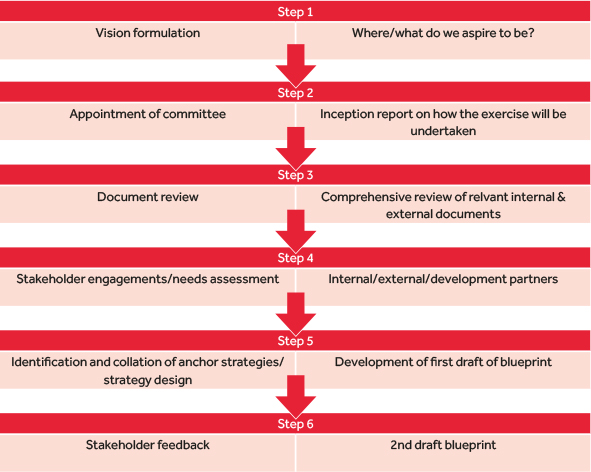
5.1 Proposed roadmap
- Vision formulation: The leader of the institution bears responsibility for formulating the vision with the help of a core team or through a wider consultative process. In the Kenyan case, the vision was formulated and documented separately to guide the development of the blueprint. Developing both simultaneously could be cost-effective and is may be preferable.
- Appointment of the committee: Identify for appointment a competent team with diverse skills sets: leadership, statistics, human resources, ICT, communications etc. The team could include individuals from outside the institution for expert support if necessary and to formalise the appointment.
- Needs assessment: Identify the most important issues that justice seekers and stakeholders would like addressed; for example, delays, huge backlogs, legal technicalities. Are there preferred alternatives to the formal justice system? Are there informal/traditional systems in place that could be given formal recognition and supported to settle disputes within the communities? Are there customer care services making the justice experience better? Will the proposed changes make the judicial services more responsive to citizens?
- Literature review: Conduct an extensive review of institutional documents, including previous reports, blueprints and strategies. External documents such as national development plans, Commonwealth reports, relevant UN reports on reforming the justice sector should also be considered.
- Stakeholder consultations: Map out the stakeholders. Identify the value of each stakeholder towards the achievement of the vision and the expectations of the institution from each stakeholder and what the stakeholder expects from the judiciary.
- Strategy design: Identify the strategic objectives, key result areas with specific interventions, and objectively identifiable indicators for purposes of monitoring and evaluating progress.
- Validation: Create a forum for all stakeholders to validate and own the strategy before approval for implementation.
- Launch: A public launch is important for public information and dissemination, taking into account the outward-looking people-centeredness of the strategy implementation. Invitations to the launch should aim at achieving the greatest dissemination impact.
- Monitoring and evaluation: develop a tool for checking progress, preferably one that is automated for greater efficiency and effectiveness.
Figure 5.1: An outline of the proposed roadmap for people-centred justice
5.2 Tips for adaptation of a people-centred justice strategy
Drawing on the experiences of Kenya, Rwanda, Bangladesh and Canada, among others, this summary distils practical lessons from these select Commonwealth countries to support the development of effective, inclusive and sustainable people-centred access to justice strategies. Based on the lessons, it suggests practical tips that could be applied by other Commonwealth countries in developing their own people-centred access to justice strategies.
1. Anchor strategies in national vision and legal frameworks
In Kenya, STAJ was aligned with the Constitution of Kenya (2010), emphasising human rights and social transformation.
TIP 1: Embed access to justice strategies in the national agenda and constitutional values of legal reform to ensure legitimacy, coherence and sustainability.
2. Use empirical data and evidence to identify justice gaps
Canada uses legal needs surveys and empirical data to guide interventions.
TIP 2: Conduct regular legal needs assessments and ensure disaggregation of date by gender, geography, age, disability, vulnerability and other factors to inform tailored interventions.
3. Build local justice infrastructure and partnerships
In Bangladesh, the Village Courts Act enables local government-led justice delivery while in Kenya Court Users Committees ensure co-ordination by bringing together stakeholders at the grassroots level.
TIP 3: Decentralise justice services and empower local justice actors by creating local multistakeholder partnerships between the judiciary, NGOs, chiefs, elders, legal aid providers and others to foster collaboration and accountability.
4. Engage communities and justice users in strategy design
In Rwanda, village-level forums and Abunzi mediators are selected by local communities, building trust. In Bangladesh, Village Courts are accessible, local and familiar to communities.
TIP 4: Use participatory consultative methods involving justice users, community consultations, including marginalised groups, legal empowerment surveys, and user feedback loops in the design and feedback processes.
5. Strengthen alternative and informal justice systems
Kenya has institutionalised alternative justice systems (AJS) through policy and pilot projects. Kenya’s AJS Policy formalises community-based justice mechanisms; Rwanda’s Abunzi mediation system is a formal pre-court mechanism embedded in law.
TIP 5: Recognise, support, regulate and appropriately link customary or informal justice mechanisms with formal systems, ensuring safeguards for human rights and equity.
6. Address inclusion and the needs of marginalised groups
Kenya’s STAJ prioritises gender, disability and minority inclusion (for example, using sign language in courts, providing mobile courts to remote areas), while Canada recognises Indigenous justice initiatives and culturally appropriate legal services.
TIP 6: Build in inclusive measures such as legal aid, translation, and accessible infrastructure for women, children, people with disabilities and Indigenous groups.
7. Leverage technology to expand reach
In Kenya, e-filing, e-payments, e-judiciary mobile applications and Mahakama Popote mobile platforms have improved remote access, while in Canada, virtual courts and online legal help which originally came to prominence during the COVID-19 pandemic continue to serve justice seekers.
TIP 7: Invest in user-friendly digital tools ensuring they are accessible to low-literacy, low-income, remote and underserved populations.
8. Institutionalise monitoring, evaluation and learning
In Rwanda, regular performance contracts (Imihigo) help track justice sector goals. Kenya’s STAJ uses a results-based management framework to monitor and track progress.
TIP 8: Develop monitoring and evaluation (M&E) frameworks with user-centred, community-level indicators and include mechanisms for feedback from justice users, incorporating regular learning loops.
9. Secure political will and multisectoral support
In Canada, there is strong collaboration across justice ministries, courts, academia and civil society. Likewise, in Kenya, access to justice reform initiatives are judiciary-led but involve multiple arms of government, with interagency co-ordination.
TIP: 9 Build high-level commitment and cross-sectional partnerships and co-ordination to mobilise resources and drive implementation of strategic reforms.
10. Pilot, learn and scale
In Kenya and Bangladesh, mobile courts and Village Courts were piloted before being scaled nationally.
TIP: 10 Start with pilot projects. Evaluate them rigorously to test the approaches and adapt suitable practices before upscaling or rolling out nationally.
11. Other tips
i. Support peer-to-peer learning through twinning programmes, study visits to other jurisdictions or online engagement platforms.
ii. Continuous leverage existing regional platforms, including Commonwealth Law Ministers Meetings and others for support and knowledge sharing.
iii. Align strategies with SDG 16.3 indicators, particularly around access, dispute resolution and user satisfaction.
iv. Mobilise support from development partners for technical assistance, training and digital infrastructure.
The experiences of Rwanda, Bangladesh, Canada and Kenya show that people-centred justice strategies must be country context specific, inclusive and evidence driven. A successful strategy balances top-down leadership with bottom-up engagement, embraces innovation and builds long-term systems for justice delivery that truly serve the people.