


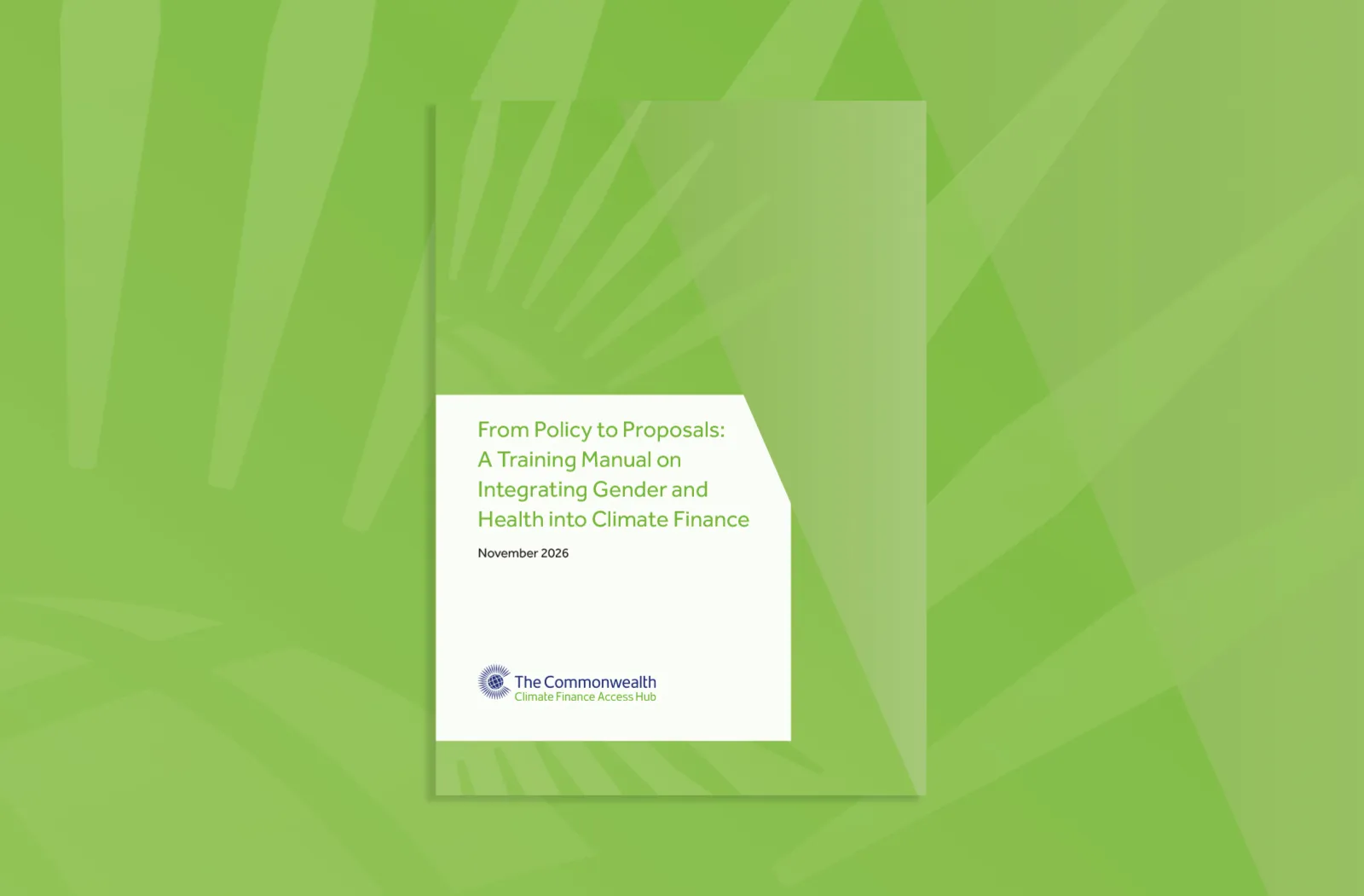
This manual equips Commonwealth National Climate Finance Advisers and their counterparts in development and government with practical tools to integrate gender and health considerations into climate finance proposals, making it possible to move from policy commitments to bankable investments.
Climate change is increasingly affecting public health systems, livelihoods, food security, water availability and socioeconomic resilience across Commonwealth countries, particularly in small island developing states and vulnerable developing countries. Women, youth, children, persons with disabilities, low-income households and marginalised populations often experience heightened vulnerability as a result of structural inequalities, limited access to resources and reduced adaptive capacity. At the same time, climate-related hazards are placing additional pressure on health systems through increased disease burdens, extreme weather events, environmental degradation and disruption to essential services.
The manual emphasises that integrating gender and health into climate finance is not an optional add-on, but a strategic requirement for improving the effectiveness, sustainability, inclusivity and bankability of climate investments. It promotes a shift from narrow mainstreaming approaches towards implementation-oriented and systems-based approaches that strengthen institutional co-ordination, climate resilience and equitable development outcomes.
This approach integrates gender-responsive climate finance throughout the project cycle, from risk analysis and project design to budgeting, implementation, monitoring, learning and sustainability. It also applies an intersectional lens, recognising that different groups experience climate and health risks differently while contributing as leaders, knowledge-holders, entrepreneurs and agents of resilience.
Structured across four chapters, the manual introduces the gender–climate–health nexus and provides practical guidance on integrating gender and health considerations across the climate finance project cycle. It includes approaches for developing concept notes, theory of change frameworks, gender analysis, gender action plans, budgeting, monitoring and evaluation, and building bankable climate finance proposals aligned with mechanisms such as the Green Climate Fund, the Adaptation Fund and other multilateral and bilateral financing mechanisms.
The manual highlights the importance of health co-benefits, climate-resilient health systems, gender-responsive budgeting, environmental and social safeguards and inclusive stakeholder engagement. In addition, it provides practical tools, scoring checklists, case studies and technical resources to support applied learning and implementation. Overall, the manual aims to strengthen institutional capacity to design and implement climate finance interventions that are gender-responsive, health-informed, socially inclusive and aligned with global climate and development frameworks, including the Paris Agreement, the United Nations Framework Convention on Climate Change Gender Action Plan, the Sustainable Development Goals (SDGs) and the COP28 Declaration on Climate and Health. Furthermore, it aims to align global policy with the ICPD Programme of Action and UNFPA’s Climate Change Strategy, alongside the Paris Agreement and the SDGs.