



This report assesses progress towards commitments made in the Commonwealth Declaration for Gender Equality and the Empowerment of Women 2022–2030, analysing the available data against each priority area by Commonwealth region in order to strengthen accountability and identify gaps in reporting.
The Declaration and the associated ‘roadmap’ of indicators was proposed by Commonwealth Women’s Affairs Ministers in 2019 and adopted by Commonwealth Heads of Government in 2022. It lays out five priority areas of focus towards gender equality and the empowerment of women:
- women in leadership
- women’s economic empowerment
- ending violence against women and girls
- gender and climate change
- accountability for gender equality.
The inaugural roadmap report was published in 2024. Since then, while there are some notable highlights such as the continued decline in rates of maternal mortality, current data on those five priority areas show slow progress – and in some cases reversed progress – since 2024. (See the summary table below for a snapshot of progress, and lack of it, between 2024 and 2026.)
The intensification of conflict and climate-related disasters, combined with tight fiscal conditions, sluggish economic growth and reduced access to development assistance has impacted progress towards gender equality across the Commonwealth. These barriers to progress have been accelerated by reports of increasing online and physical violence towards women, and organised social movements that oppose gender equality.
Levels of women’s leadership in government and the private sector remain similar to those reported in the 2024 report. Concerted efforts are required to increase the proportion of women in leadership and develop the pipeline of young women leaders.
In terms of women’s economic empowerment, data show very slow progress since the last report, and some deterioration – for example, the 8 percentage point drop in the proportion of females enrolled in secondary schools. While one country added legislation prohibiting gender discrimination in employment, women’s labour force participation remains unchanged overall. Women’s unpaid domestic and care work remains unequal and continues to be a significant barrier to women’s access to educational and economic opportunities.
Data show rates of violence against women – in terms of child, early and forced marriage; physical and sexual violence; and intimate partner violence – remain concerningly high across the Commonwealth.
One positive is that maternal mortality has decreased by almost 13 deaths per 100,000 live births across the Commonwealth since the previous report.
While the unequal gendered impact of climate change and climate-related risk is acknowledged by member countries, both representation and the collection and analysis of data on the issue is limited. Women were represented in only half of consultations on updating member countries’ national climate commitments under the Paris Agreement (Nationally Determined Contributions, or NDCs). Only small minorities of NDCs include gender-responsive funding for climate initiatives, and are informed by gender-disaggregated data – though several intend to or are considering doing so.
This report presents deeper analysis on the data, and data availability, by region under each priority area to strengthen accountability on gender equality. In general, consistent and systematic gender-disaggregated data are required to better understand and address gender inequalities in all priority areas, especially violence against women and girls.
Published in tandem with this report is The Pushback against Gender Equality and Women’s Empowerment in the Commonwealth Dynamics and Implications, which analyses the impact of the intensifying, organised and often well-funded opposition to gender equality initiatives in many Commonwealth countries. |
Image
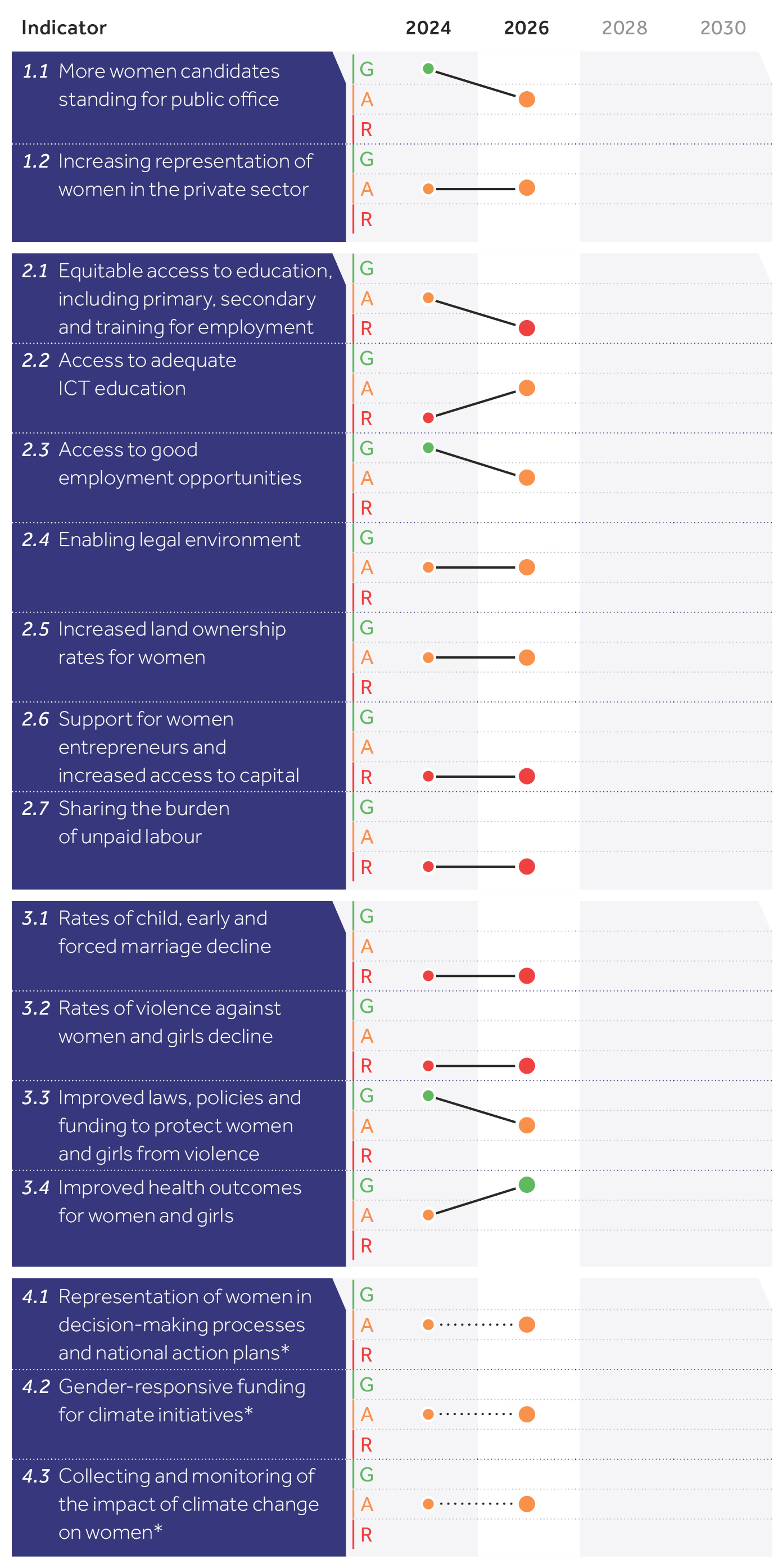
Table A: Summary table on improved (green), static/mixed (amber) and deteriorated (red) indicators of gender equality and women's empowerment in this report, 2024 and 2026
*Note: Because the methodology used to assess progress against indicators 4.1–4.3 has changed since the 2024 report, their 2024 and 2026 ‘scores’ are not directly comparable.
Copyright (c) 2026 Commonwealth Secretariat