



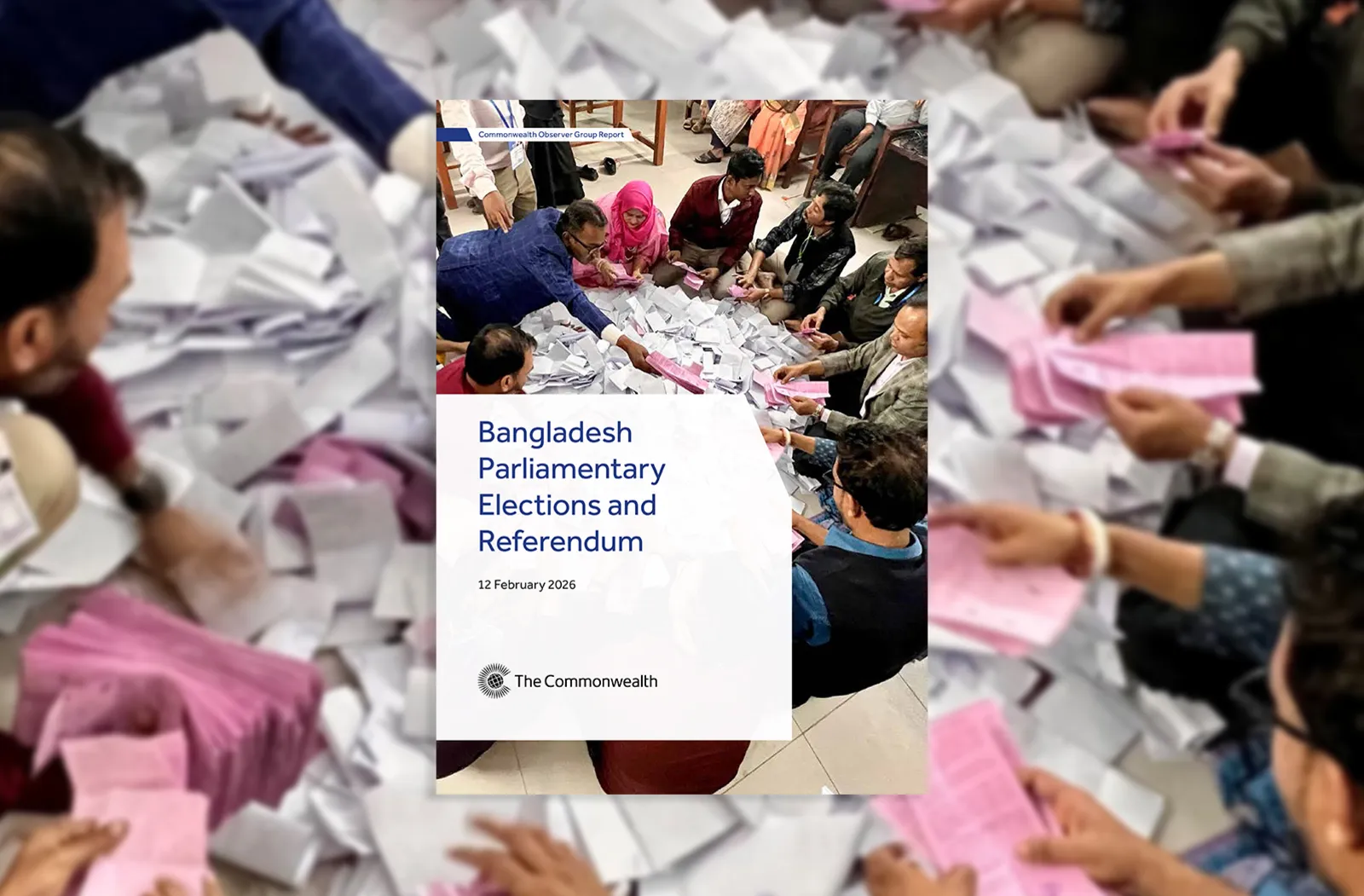
This is the final report the Commonwealth Observer Group constituted by the Commonwealth Secretary-General for the parliamentary elections, and referendum on the July Charter, held in Bangladesh on 12 February 2026, at the invitation of the Chief Election Commissioner. Assessing this landmark event in Bangladesh's political history, it offers recommendations on how to deepen democracy and strengthen the country's institutions and electoral processes.
Executive Summary
About the Commonwealth Observer Group
The Commonwealth Secretary-General, the Hon. Shirley Botchwey, established a Commonwealth Observer Group (COG) to visit Bangladesh to observe the 13th parliamentary elections and the referendum on the July Charter, held on 12 February 2026. The COG was constituted at the invitation of the Chief Election Commissioner of the Bangladesh Election Commission (BEC).
The COG comprised eminent persons drawn from across the Commonwealth, including politicians, diplomats and experts in election management, law, media and civil society, with expertise spanning issues including gender, youth and persons with disabilities (PWDs).
The Group was present in Bangladesh from 4 to 18 February 2026. In fulfilling its Terms of Reference, it engaged with a wide range of stakeholders. These included Chief Adviser Muhammad Yunus and other members of the interim Government of Bangladesh, the Chief Justice, the Chief Election Commissioner and other BEC officials, the Chief of Army Staff and the Inspector-General of Police.
The Group also met representatives of political parties; media agencies; online monitoring and factchecking groups; civil society organisations including women’s and youth groups; PWDs; Commonwealth High Commissions; international organisations; other international observer missions; and citizen observer groups.
About the elections and referendum
The 13th parliamentary elections and the referendum on the July Charter were held within the context of the July 2024 uprising, which represented a significant event in Bangladesh’s political history, marking a transition from Awami League-led governance to a renewed democratic trajectory. Stewardship of this transition fell to the interim administration led by Nobel Peace Prize laureate Muhammad Yunus. Although Yunus was unelected, the period of transition underpinned his fourfold mandate: to restore law and order, rebuild state institutions through reform commissions, ensure accountability, and deliver credible elections alongside a constitutional referendum on the July Charter.
The 13th parliamentary elections were conducted for the 350-member unicameral parliament (Jatiya Sangsad), comprising 300 directly elected constituency seats and 50 seats reserved for women allocated based on proportional representation. A total of 51 political parties were registered, with 2,034 candidates contesting the elections. The elections were held in only 299 constituencies because of the sudden passing of a candidate in one constituency.
With a total of 127,711,793 registered voters, the Bangladesh elections marked the largest democratic undertaking in the Commonwealth in 2026. For the first time, postal voting was extended at scale to diaspora voters and individuals in lawful custody. This is a commendable innovation, enfranchising a greater number of citizens, including approximately 772,000 overseas voters across 122 countries.
Findings
While scepticism about the BEC’s independence and capacity persisted, rooted partly in controversies surrounding the January 2024 elections and the barring of the Awami League, the Group’s overall assessment is that the elections were peaceful, orderly and transparent. The voting, counting and results management processes were conducted in a professional manner. The Group commends the BEC and polling staff for conducting their duties with professionalism and diligence.
Security arrangements were unprecedented in scale, with nearly one million personnel deployed through a joint security framework. Technological innovations, including drones, body-worn cameras, CCTV monitoring and a dedicated cybersecurity cell, supported real-time oversight without compromising ballot secrecy. Notwithstanding isolated incidents, these arrangements contributed to a peaceful environment for the elections. The Group lauds the professionalism within which the security agencies conducted themselves. The Group also applauds the people of Bangladesh for exercising their franchise in an orderly and peaceful manner.
The Group noted limited public awareness of the referendum’s substance and concerns about the secondary role of political parties in shaping the July Charter. However, the COG observed that the referendum passed with 47,225,980 votes.
The elections also highlighted important dimensions of inclusion. Women constitute roughly half the population and benefit from 50 constitutionally reserved parliamentary seats, with an additional 50 proposed under the July Charter. However, only about 4 per cent of candidates for constituency seats were women, and just seven women were directly elected in 2026, underscoring the need to promote women’s participation and representation. Nevertheless, the Group noted that civil society organisations continued to play a constructive role in promoting gender equity and broader democratic reforms.
Youth representation and participation remain a concern. Although citizens under 35 comprise approximately 44 per cent of the Bangladeshi electorate and were instrumental in the 2024 protests, their representation in party leadership and participation as candidates remained low. The Group proposes more meaningful youth engagement in Bangladesh’s political and governance processes.
By contrast, there appeared to be tangible progress on matters relating to the inclusion of PWDs, including the introduction of the first-ever braille ballots and structured assistance programmes. These innovations marked a significant administrative advance in ensuring electoral inclusion. More still needs to be done to ensure greater inclusion of PWDs, including providing accessible polling stations.
The Group noted that the media was vibrant and active. The media environment during the campaign was notably more open than in previous cycles. Some newspapers and television channels provided broad and balanced coverage. Nonetheless, attacks on media offices in December 2025 underscored persistent risks to press freedom.
The restrictive legal environment created by the Communication and Technology Act and the Cyber Security Act contributed to a ‘media chill,’ resulting in Bangladesh ranking 149th out of 180 countries in the 2025 World Press Freedom Index.
Digital platforms – primarily Facebook but also YouTube, TikTok, WhatsApp and X (formerly Twitter) – served as primary arenas of political contestation, amplifying both civic engagement and misinformation. In response, the BEC established a media monitoring and cybersecurity unit and launched youth-oriented digital outreach initiatives.
Ultimately, the February 2026 parliamentary elections and referendum represented a historic juncture, being administratively innovative and largely peaceful and transparent. However, there is room for further improvement. As Bangladesh moves forward, consolidating institutional trust, addressing political divisions, broadening women’s and youth representation and strengthening safeguards for media freedom and digital integrity will be central to deepening the democratic gains of this pivotal transition.
This report presents a set of recommendations for consideration by key stakeholders in Bangladesh. They are offered in a constructive spirit, with the aim of deepening democracy and further strengthening the country’s institutions and electoral processes.
Copyright (c) 2026 Commonwealth Secretariat