


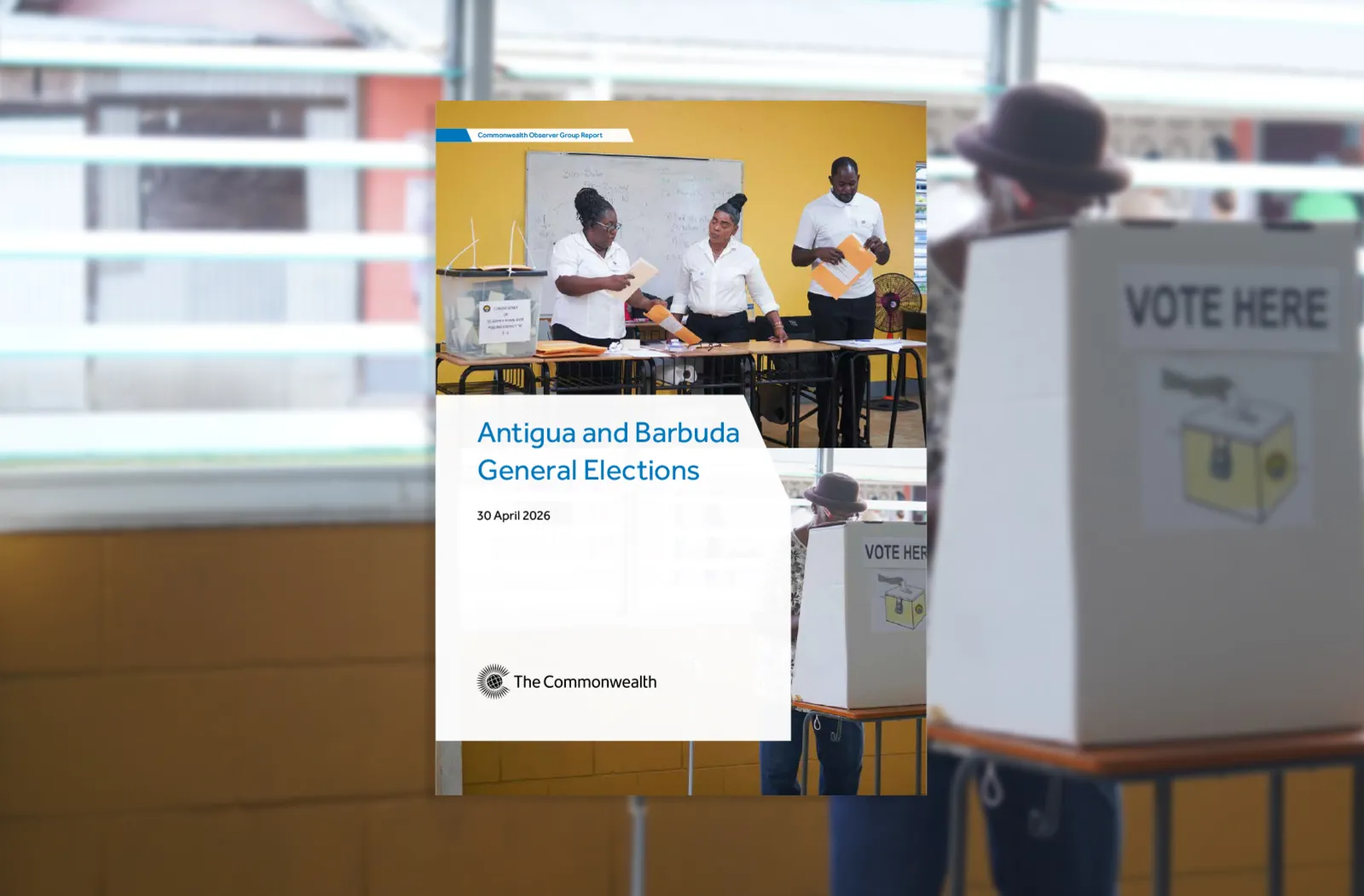
This is the final report the Commonwealth Observer Group constituted by the Commonwealth Secretary-General for the general elections held in Antigua and Barbuda on 30 April 2026, following an invitation from the government. In it, the Group assesses the electoral process and the wider democratic context, and sets out recommendations for consideration by key stakeholders.
Executive summary
The Commonwealth Secretary-General, the Hon. Shirley Botchwey, constituted a Commonwealth Observer Group (‘the Group’) for the 30 April 2026 Antigua and Barbuda general elections, following an invitation from the government.
The Group, led by Hon. Pelonomi Venson, former Minister of Foreign Affairs of Botswana, comprised four eminent persons with expertise in politics, elections, media and civil society. During its mission, the Group engaged a broad range of stakeholders, including the Governor-General, the Prime Minister, the Minister of Foreign Affairs, political parties, the Antigua and Barbuda Electoral Commission (ABEC), the police, the media, civil society, and the Commonwealth diplomatic representative.
The Group found that the elections were conducted in a peaceful, orderly and transparent manner. Polling procedures were generally followed, polling staff performed their duties professionally, and political parties, security personnel, the media and the electorate contributed to the overall conduct of the process.
The Group observed final campaign activities and deployed members across all 17 constituencies on election day.
The campaigns were energetic and highly visible, marked by rallies, motorcades, community outreach, media engagement and active political mobilisation. Fundamental freedoms, including those of expression, assembly and association, were broadly respected, although the Group noted instances of personal attacks and inflammatory commentary, particularly on social media.
The 2026 general elections took place under a compressed timetable following the dissolution of Parliament on 1 April 2026 and the subsequent announcement of elections on 7 April 2026. This expedited process tested electoral institutions and required accelerated adjustments to voter registration, transfers, verification, claims and objections. While ABEC is commended for its voter education efforts, particularly during the Expired Voter’s ID [identification] Card Replacement Programme, the shortened timeframe raised concerns about whether all eligible voters had sufficient opportunity to confirm their registration status.
The Group noted that Antigua and Barbuda’s legal and regulatory framework broadly provides an adequate basis for democratic elections. However, several areas require reform. These include strengthening the independence of the Electoral Commission, reviewing constituency boundaries to address disparities in registered voter numbers, introducing clearer timelines for election petitions, and improving the regulation, transparency and enforcement of campaign finance rules.
Participation and inclusion remain critical areas for attention. Women played a central role in election administration, forming the majority of polling staff, including as presiding officers, yet their representation as candidates declined from 19.6 per cent in 2023 to 13.5 per cent in 2026.
Antigua and Barbuda has a youthful demographic. Youth were visible in polling activities, particularly as poll clerks and information officers, but remained underrepresented in formal political leadership roles. Their role as administrators reflects a strong level of civic consciousness, which has yet to translate into meaningful inclusion in political processes. Persons with disabilities continued to face significant structural barriers, with many polling stations remaining physically inaccessible.
In view of the gaps in the meaningful participation of women, youth and persons with disabilities, the Group recommended targeted reforms. These include a national gender policy, internal or legislated party quotas, stronger youth engagement, and the collection of data on disability during voter registration to enable the early mapping of polling stations and ensure that specialised assistive materials are deployed where they are most needed.
The media environment was active and pluralistic, with radio, television, online platforms and social media playing important roles in informing voters. However, concerns were raised about political polarisation, editorial independence, alleged bias in state-owned media and the absence of a codified election-specific media code of conduct. The Group also noted the absence of printed newspapers, which may limit access to information for older voters and citizens who are less active online.
The Group noted the declining voter turnout, which fell from 76.51 per cent in 2018 to 70.34 per cent in 2023 and 62.41 per cent in 2026, suggesting a need for deeper analysis of voter engagement and public confidence.
Overall, the Group commended the people of Antigua and Barbuda, ABEC, the police and other institutions for the peaceful and transparent conduct of the 2026 general elections. At the same time, the Group emphasised that continued democratic consolidation will require reforms to strengthen electoral independence, campaign finance oversight, constituency delimitation, dispute resolution, inclusive participation, media fairness and public confidence in the electoral process.
This report sets out a set of recommendations for consideration by key stakeholders in Antigua and Barbuda. They are offered in a constructive spirit, with the aim of deepening democracy and further strengthening the country’s institutions and electoral processes.