



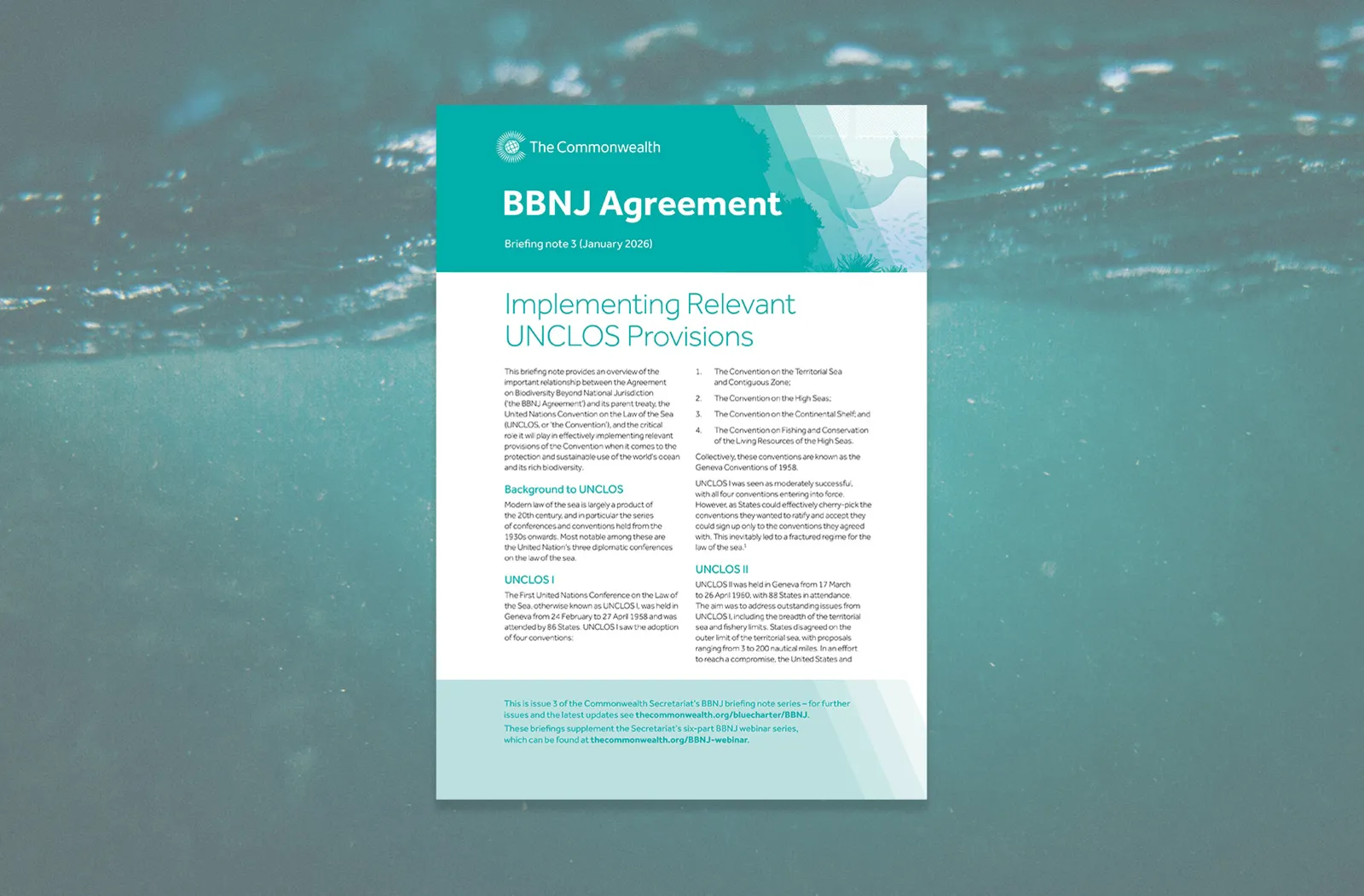
This briefing note provides an overview of the important relationship between the Agreement on Biodiversity Beyond National Jurisdiction (‘the BBNJ Agreement’) and its parent treaty, the United Nations Convention on the Law of the Sea (UNCLOS, or ‘the Convention’), and the critical role it will play in effectively implementing relevant provisions of the Convention when it comes to the protection and sustainable use of the world’s ocean and its rich biodiversity.
UNCLOS marked a significant turning point in ocean governance. It was the first international agreement to codify rules and principles for the protection of the entire marine environment. However, its provisions relating to environmental protection are only of a framework nature – and the significant expansion of the anthropogenic footprint in marine areas beyond national jurisdiction (ABNJ) has exposed gaps and limitations in that framework.
The drafters of UNCLOS anticipated that subsequent treaties to would be needed to address new challenges in the law of the sea, and to rectify problems or omissions in the Convention. This has been pursued through the creation of implementing agreements, of which the BBNJ Agreement is the third.
The BBNJ Agreement’s purpose is not to deal with ocean governance matters afresh or to amend or revise the environmental protection provisions enshrined in its parent treaty. Instead, its general objective is to ensure the conservation and sustainable use of marine biodiversity of ABNJ through the effective implementation of relevant provisions of the Convention, and through further international co-operation and co-ordination.
This briefing provides an overview of the development of both UNCLOS and the BBNJ Agreement, and explores how the latter fills in gaps left behind by its parent treaty through an examination of each of the four elements of its 'package deal':
- marine genetic resources, including the fair and equitable sharing of benefits
- measures such as area-based management tools, including marine protected areas
- environmental impact assessments
- capacity-building and the transfer of marine technology.
For more information visit our page: Biodiversity beyond national jurisdiction
We support member countries with capacity-building and technical assistance for effective BBNJ Agreement ratification and implementation.