


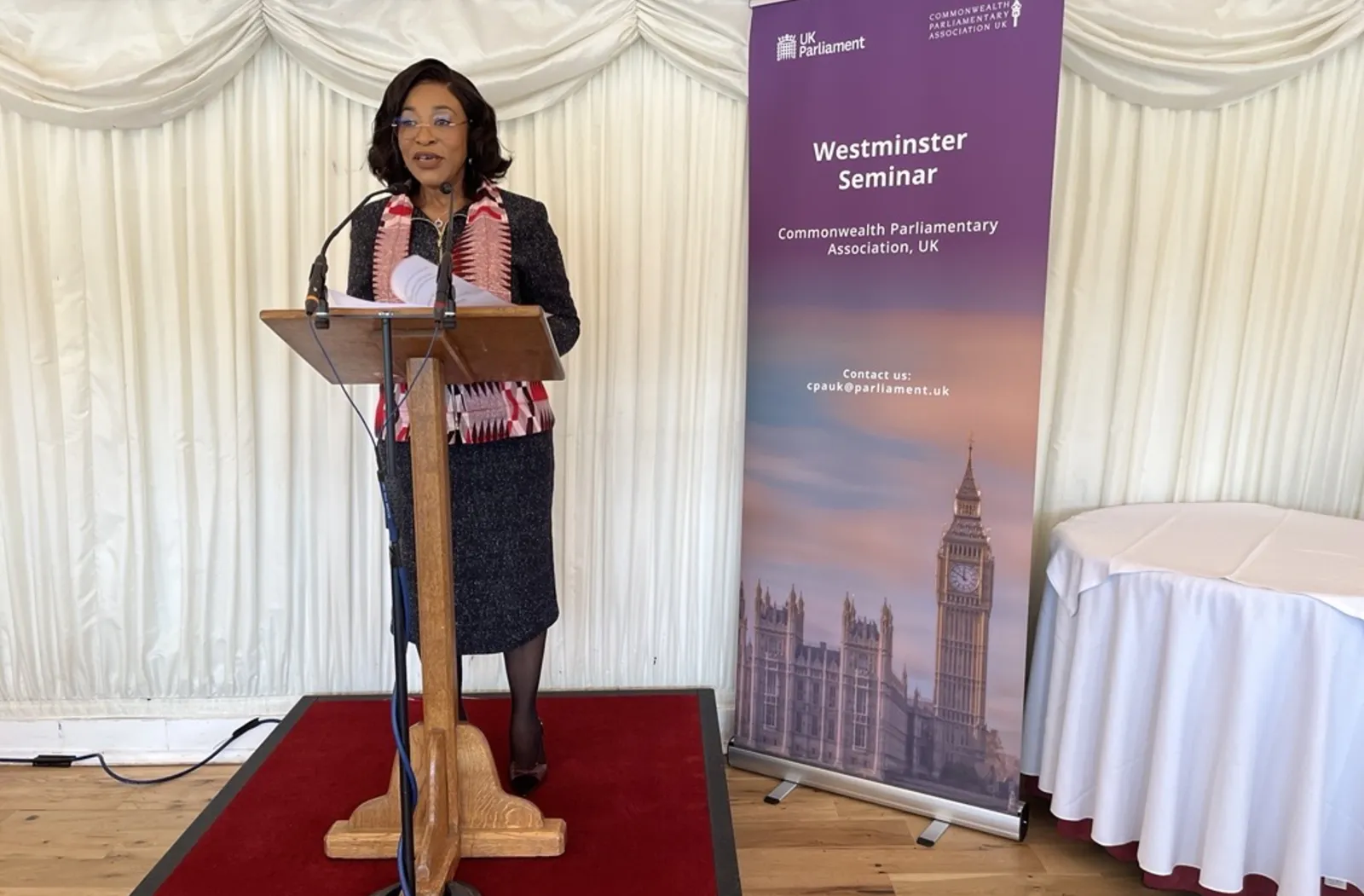
Keynote address by the Commonwealth Secretary-General, Hon Shirley Botchwey, at the United Kingdom Commonwealth Parliamentary Association 74th Westminster Seminar at Cholmondeley Room, House of Lords, London on 12 March 2026.
It is a real pleasure to be with you today.
I thank the Commonwealth Parliamentary Association UK – and especially you, Kate – for hosting this Westminster Seminar and for the vital role you play in strengthening parliamentary practice across our Commonwealth family.
This gathering is itself a powerful reminder of what makes the Commonwealth unique, from the history and traditions of the houses of Parliament where we meet today; to the new, diverse but evolving community of practice that we are all forging to respond to the expectations of our peoples.
In this room we are blessed with the presence of parliamentarians and officials from every region of our association – from Africa and the Caribbean, to the Pacific, South Asia, and our partners here in the United Kingdom and the wider Commonwealth parliamentary community. Different histories. Different political systems. Different national development plans.
Yet united by a shared commitment: that democracy, accountable governance, and the rule of law remain the strongest foundation for stability, prosperity, and trust between citizens and their institutions. And now faced with new threats to our democratic, economic and environmental resilience, after decades of an international rules-based international order that no longer worked for either the industrialised or developing members of our Commonwealth, united to make this our moment of strategic opportunity.
Making democracy work for increased intra-Commonwealth trade and investments; for skills, entrepreneurship and opportunities for our women and youth; and for environmental resilience, leveraging the resulting shared prosperity for a democratic dividend for each Commonwealth citizen. It is that commitment that is driving our preparations towards the Commonwealth Heads of Meeting (CHOGM) in Antigua and Barbuda.
And it is that commitment that makes the Commonwealth not simply an organisation of governments — but a living network of democratic and civic institutions. We all know that this is a moment of profound global change.
Across the world we see a convergence of pressures: geopolitical tension, economic uncertainty, climate disruption, and growing strain on democratic institutions. I am sure, like me, you have followed the debates at Davos and the Munich Security Conference. While the point has been rightly made about the importance of the rules -based international order, the so-called rupture refers to an international order that world leaders had declared ineffective only a year and half ago at the Summit of the Future at the United Nations in New York.
In many societies, public trust in political systems is weakening. Citizens are asking whether democracy is delivering the security, opportunity and fairness they expect. In both democracies and non-democracies, progress has been accompanied by growing inequality that appear to be immune to solution. And despite the efforts to strengthen international trade and development cooperation, growth has lagged and threatens individual well-being and social protection.
The solutions being proffered address the disruptions and the instability that come from the unilateralism of big powers. They do not address how to create shared prosperity that touches each person and protects our planet. And that, I believe, is why we have a unique opportunity as the Commonwealth. We remain one of the few global networks built on voluntary partnership, shared values and practical cooperation.
We all know the numbers: Fifty-six countries. One third of humanity. 60% of our people under thirty. That combination gives our association both responsibility and potential.
In September, last year our Member States endorsed a new 5-year Commonwealth Strategic Plan focused on strengthening resilience – democratic, economic, environmental with youth, women, and Small States as a priority. Both the Strategic Plan and the upcoming CHOGM, whose theme is “Accelerating Partnerships and investment for a Prosperous Commonwealth”, are designed to promote the missing shared prosperity across the Commonwealth.
But, as you know, strategies alone do not deliver change. Institutions do. Leadership does. And parliaments do. In fact, I think parliaments will be essential to our efforts to renew the Commonwealth. Our Charter sets out our shared commitment to democracy and accountable governance. Those principles thrive or fail in parliaments.
Because parliaments are where democratic legitimacy is tested. You debate the policies that shape your societies. You scrutinise the executive. You ratify international commitments. You pass the laws that translate political promises into reality. Without strong, independent, capable parliaments, the Commonwealth’s wider ambitions – for economic growth, climate resilience, and opportunity for young people – cannot be realised.
So parliamentary cooperation is paramount, and the CPA is essential. And I think there is more we can do together. If we are serious about strengthening democratic resilience, then parliamentarians should not only observe the Commonwealth’s work – you should be an active part of it. We can work together over time to shape exactly how, but let me make a few practical suggestions:
First, we could expand opportunities for parliamentarians to participate in Commonwealth electoral observation missions. Election observation has long been one of the Commonwealth’s most respected democratic tools. But including parliamentarians more systematically in these missions strengthens both credibility and peer learning. Few people understand the realities of political competition, democratic accountability and electoral legitimacy better than those who live them. Your experience is invaluable.
Second, we could further enhance the inclusion of parliamentarians in national delegations to key international gatherings, especially their role and voice. Diplomacy increasingly shapes domestic policy – whether on climate, trade, technology or finance. The promises Governments make on the international stage cannot be implemented without the legislature. By involving parliamentarians early in the diplomatic process, we create stronger national ownership – and a clearer pathway from international agreement to domestic implementation.
Third, we could strengthen parliamentary processes around major international milestones. That means bridging the gap between summits and real-world policy through committee scrutiny, through cross-party engagement, and through public debate that builds political consensus for long-term commitments. In an age when technological change and global crises move faster than traditional policymaking cycles, this alignment between society, diplomacy and legislative process is more important than ever.
Fourth, the Commonwealth can benefit from sharing parliamentary innovations more systematically across our network. Every Commonwealth country brings valuable experience.
One example here in the United Kingdom is the Liaison Committee, where select committee chairs question the Prime Minister in depth on government policy. It is a powerful model of parliamentary scrutiny – drawing on detailed subject expertise and providing meaningful democratic accountability.
Across the Commonwealth, there are many other examples: innovative committee systems, digital parliaments, citizen engagement mechanisms. By sharing these practices more widely, we strengthen democracy across all our institutions.
I know this is work the CPA already takes seriously. It is important and I want to support it. All of this work takes on even greater importance as we look ahead to the next Commonwealth Heads of Government Meeting in Antigua and Barbuda. CHOGM remains the moment when leaders set the direction for our Commonwealth family.
But its success will depend not only on the decisions taken by governments. It will depend on the political environment within our member states. And that environment is shaped n large part by parliaments. By the debates you lead. By the scrutiny you exercise. By the national consensus you help build around shared commitments.
In other words: the future of the Commonwealth may be directed by leaders, but it will be determined by parliaments. Ultimately, the Commonwealth’s promise rests on a simple principle. Democratic resilience is the foundation of everything else we seek to achieve. Without strong democratic institutions, economic growth cannot be inclusive. Without accountable governance, climate action cannot endure. Without public trust, international cooperation cannot succeed. That is why strengthening parliaments is not a technical exercise. It is central to the Commonwealth’s future.
Honourable Members,
The founders of the modern Commonwealth believed that cooperation between democratic nations could help build a more stable and prosperous world. Today that belief is being tested – but its central tenets stand. It is parliamentarians – across parties, across nations, across regions – who help keep that belief alive in practice.
So I thank you for your leadership. I thank the CPA for the work you do. I look forward to our discussion today. And I look forward to working closely with you as we build a stronger, more resilient, and more impactful Commonwealth in the years ahead.
Thank you.