



By Attila Shaaran, Economic Research Officer and Dr Thomas Munthali, Head of the Economic Policy and Small States Section at Commonwealth Secretariat
The conflicts in Ukraine and the Middle East have once again shown us how closely connected today’s global economy has become. For Commonwealth countries, particularly small states and developing economies, events thousands of miles away can quickly expose how dependent they are on imported food and fuel, how little room governments may have to absorb new costs, and how vulnerable they can be to concentrated export markets and global supply chains largely beyond their control.
The lesson is increasingly clear. We are no longer preparing for one crisis at a time but for an era in which geopolitical uncertainty is likely to remain a feature of the global economy.
The speed at which conditions can change is striking. Between its January and April 2026 World Economic Outlooks, the International Monetary Fund (IMF) revised projected global growth down from 3.4 per cent to 3.1 per cent. Its global inflation forecast rose from 3.7 per cent to 4.4 per cent, projected world trade growth fell from 3.3 per cent to 2.8 per cent, and the assumed average oil price increased from around US$63 to US$82 per barrel.
These projections will continue to change as conflicts, diplomacy and markets evolve. But they show how quickly geopolitical developments can reshape the global economic outlook for all of us.
While the intensity of individual conflicts may rise and fall, the broader forces reshaping the global economy are likely to persist. We are seeing strategic competition among major powers, disruptions to the rules-based international order, evolving trade relationships, supply chain reconfiguration and climate-related disruptions create a more fragmented and uncertain international environment.
Impacts within the Commonwealth
For Commonwealth countries, the challenge is not simply to weather the current storm but to become better prepared for the next ones.
At the time of writing, diplomatic efforts have at times reduced the risk of wider regional escalation, tensions in the Middle East remain fragile, affecting energy markets and key maritime trade routes. In tandem, the conflict in Ukraine continues to disrupt global supplies of grain, fertiliser and energy, while competition among major economies is reshaping trade, investment and technology flows.
We can already see the effects across every Commonwealth region, although they are not felt equally.
Many Asian Commonwealth economies remain highly integrated into global manufacturing and are particularly exposed to higher transport and energy costs. Caribbean countries, including The Bahamas, Barbados, Jamaica and Trinidad and Tobago, rely heavily on imported food and fuel, meaning global price increases can quickly feed into household living costs.
The picture in Africa is mixed. Some commodity exporters, including Ghana, Nigeria and Zambia, have benefited from stronger prices, while many import-dependent countries, such as Malawi and Sierra Leone, face higher food and energy costs, tighter financing conditions and growing debt burdens.
IMF projections suggest that Asia faces the sharpest growth slowdown owing to its deep integration into global supply chains, while Caribbean economies experience some of the strongest inflationary pressures. Africa appears relatively more resilient, although from a higher inflation base.
For many of our developing and small states, particularly Small Island Developing States (SIDS), these shocks come on top of existing challenges, such as climate change, natural disasters and constrained public finances.
Image
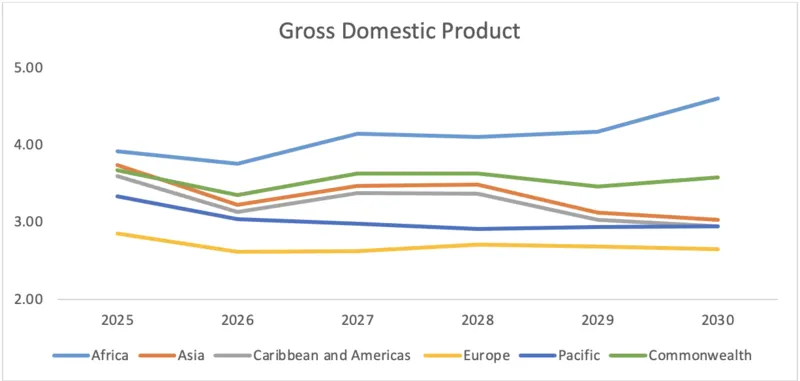
Figure 1: Projected economic performance in the different Commonwealth regions (IMF World Economic Outlook, 2026)
Turning disruption into opportunity
But experience teaches us that periods of disruption can also create opportunities to adapt.
The Commonwealth has advantages that become more valuable as global economy fragments. The 2024 Commonwealth Trade Review showed that trade costs between two Commonwealth countries are 21 per cent lower than those with non-Commonwealth countries, on average. We call this “Commonwealth advantage” which reflects our shared legal traditions, common business practices, widespread use of English and long-standing institutional relationships that make it easier, cheaper and faster to do business with one another.
As businesses look for new markets and more resilient supply chains, we have an opportunity to make greater use of this advantage.
The clean energy transition offers another route to greater resilience. Recent volatility in fossil fuel markets reinforces the economic case for renewable energy, battery storage and resilient electricity systems. For many Commonwealth small states, investment in solar, wind and other renewable technologies is no longer about meeting climate goals but reducing fuel import bills, improving energy security and creating new jobs.
Need for deliberate action
None of this will happen automatically. It requires deliberate choices and stronger co-operation across the Commonwealth.
Governments will need to protect economic stability while ensuring support reaches the households that need it most. Credible fiscal policies and sustainable debt management will remain essential, particularly as borrowing conditions become more uncertain.
Investing in domestic food production, renewable energy, logistics and digital connectivity can also reduce against future shocks. Greater regional co-operation on supply chains, trade and knowledge sharing can help reduce vulnerabilities that no country can address alone.
The question is no longer whether another external shock will occur, but how prepared we will be when it does. By diversifying trade, accelerating the clean energy transition and investing in resilient and inclusive economies, Commonwealth countries, especially small states and SIDS, can turn a period of global uncertainty into an opportunity for sustainable growth.