


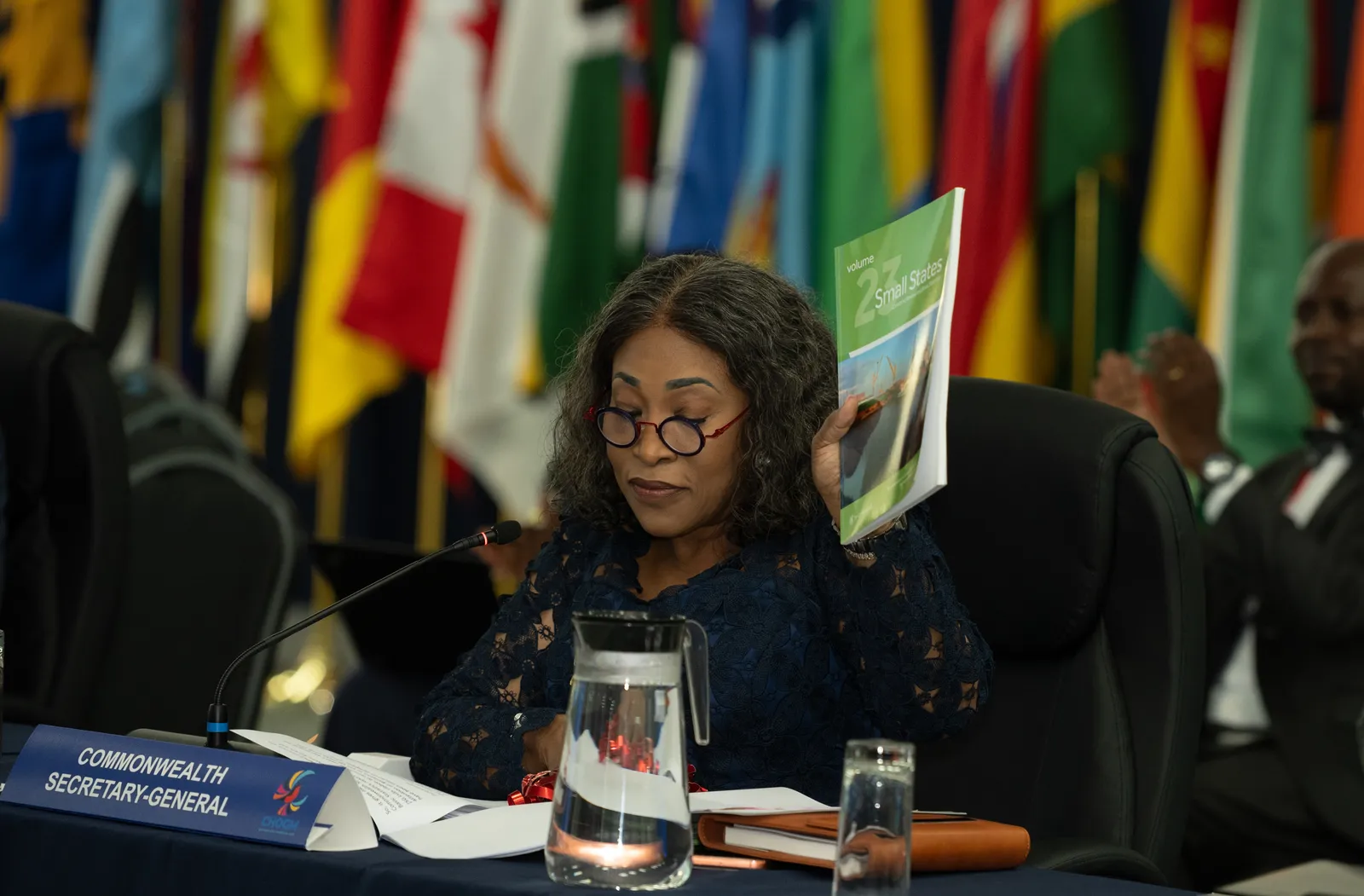
Statement by Commonwealth Secretary-General, Hon. Shirley Botchwey at the Commonwealth Ministerial Meeting on Small States (CMMSS) on Sunday 1 November 2026 at the AUA Conference Centre, St John’s, Antigua and Barbuda.
Welcome to this Commonwealth Ministerial Meeting on Small States.
Where better to host it than in Antigua and Barbuda, the birthplace of the Antigua and Barbuda Agenda for Small Island Developing States?
As the smallest nation by population ever to host a Commonwealth Heads of Government Meeting, this beautiful twin-island nation is an exemplar of the boundless potential that small states bring to our family of nations.
Thank you to the Government and people of Antigua and Barbuda for their warm hospitality.
Colleagues, we meet here at an uncertain time for the world.
A time of geopolitical tension and economic fragmentation. Of climate crises, including a looming super El Niño, and of financial vulnerabilities that place unfair pressures on small states.
These are daunting challenges. But Commonwealth small states have the talent and resilience to meet them.
Across the Commonwealth, small states are generating the solutions, from climate action and digital innovation to sustainable finance initiatives and the blue economy.
Because size need not be a limitation. It can be a source of agility.
It can be a source of agility, letting you move faster to identify and solve problems.
The question is, how can we secure the partnerships, the investment and the enabling conditions needed to meet our challenges and achieve sustainable prosperity?
This Ministerial Meeting provides an opportunity to reflect on that challenge and to identify practical solutions.
When we talk about resilience, we do not just mean the ability to rebuild after a disaster, vital though that is.
We also mean diversifying economies so they can withstand shocks.
We mean creating more and better jobs, so people can face uncertainty with a secure livelihood.
And we mean giving our young people the skills they need to find work or start a business in a changing world.
No nation, large or small, can do that on its own.
It takes partnership. Not just any partnership. A partnership that is intentional- defining actions that reflect the scale of our ambitions.
Between governments and international institutions, between development partners and philanthropists, between researchers and the private sector.
A partnership that unlocks the private capital, which dwarves the resources of the public sector.
For long-term investment in infrastructure, renewable energy supply, digital connectivity and transport networks.
This week we shall see our partnership for investment in action. Our member countries have submitted bankable projects valued at over 34 billion United States Dollars.
We hope to follow up this CHOGM with a Commonwealth Investment Week next year in the margins of our next Commonwealth Ministers of Trade Meeting.
In addition, I am determined that we eliminate the biggest obstacle small states face in servicing their debt sustainably and accessing concessional funding.
A financial system that responds to the needs of small states will be better equipped to serve all its members.
So, we are determined to move the agenda for a more responsive and equitable international financial system from advocacy to action. This requires the commitment of Commonwealth leaders to using the Bridgetown Initiative and the Antigua and Barbuda Agenda for SIDS (ABAS 4) as our common platform for our engagement in key decision-making groups our members belong to, such as the G7, G20, the Paris Club etc and at the IMF and World Bank.
The recognition of vulnerability alongside income in determining sustainable debt and concessional funding should be non-negotiable.
The Commonwealth Secretariat stands squarely behind that agenda. We will work closely with OECD and UNDP as well as relevant international NGOs to amplify the global agenda to address this single most obstacle to resilience building and shared prosperity.
While Commonwealth small states may be the focus of our ministerial meeting, let no one forget that the success of our small states is the success of our family of nations. We cannot achieve our wider Commonwealth goal of resilience and shared prosperity, without the contribution of small states to our trade and investment agenda; to our climate ambitions and to our strengthening our common values.
That is why we need the support of all our member countries to prioritise our advocacy, our technical assistance and our capacity-building programmes for small states.
Our team in Geneva works every day to help Commonwealth small states engage globally on trade, health and human rights issues.
The Meridian Debt Management system goes from strength to strength.
Through the new 2025-2030 Strategic Plan, we are introducing flagship initiatives and scaling up those that are already helping small states unlock investment.
The Climate Finance Access Hub is mobilising new sources of capital, alongside the Blue Charter Project Incubator and the COP29 Presidency-Commonwealth Fund for SIDS.
This CHOGM is built around a new approach, connecting member states with investors through the Commonwealth Bankable Investment Projects Initiative and the Commonwealth Investment Network.
The ambition underlying all this activity is to support small states to maximise opportunities for growth and prosperity working with, and connecting to, the larger Commonwealth and its opportunities.
That inspires the theme of today’s meeting.
And it is reflected in the publication that I am pleased to launch this afternoon: the 23rd volume of the Commonwealth Small States Economic Review and Basic Statistics, "Beyond Resilience to Strategic Relevance: The Future of Small States."
Strategic relevance means small states shaping the decisions that affect them and turning assets and ideas into opportunity for their people.
The future of Commonwealth small states should not be defined by an assessment of their vulnerabilities.
It should be defined by an appreciation of their strengths, their innovation, their aspirations and their capacity to contribute to global prosperity.
Many small states serve as custodians of vast ocean spaces, rich in biodiversity and critical natural assets.
They are leaders in environmental stewardship, experts in maritime governance, upholders of democratic values and pioneers of sustainable development.
These contributions generate benefits that extend well beyond their borders.
The Review makes the case for small states as indispensable partners in shaping global solutions, using their assets to strengthen regional and international partnerships.
It includes a special report on Enhancing Investment Through Public-Private Partnerships in Commonwealth Small States, which connects directly to our CHOGM theme: accelerating partnerships and investment for a prosperous Commonwealth.
Public-private partnerships are powerful vehicles for mobilising investment.
A stronger pipeline of bankable projects, more effective institutions to oversee them and innovative approaches to unlock new private capital are the foundations of greater strategic relevance for our small states.
So, it gives me great pleasure to launch officially the Commonwealth Small States Economic Review and Basic Statistics report.
Excellencies,
Our Ministerial Meeting today is a precious opportunity to strengthen our collective Commonwealth agenda for resilience building and shared prosperity.
We have the chance now to deepen our partnerships and mobilise the investment needed to translate ambition into action.
I hope today’s discussion helps us identify the practical steps that will enable our small states to shape decisions that affect them, expand opportunity for all their people and make this the Commonwealth’s moment of opportunity.