

Prime Minister Browne, Secretary-General,
Presidents, Prime Ministers, Your Excellencies,
Ladies and Gentlemen,
The Queen and I are delighted to join you for this twenty-eighth Commonwealth Heads of Government Meeting.
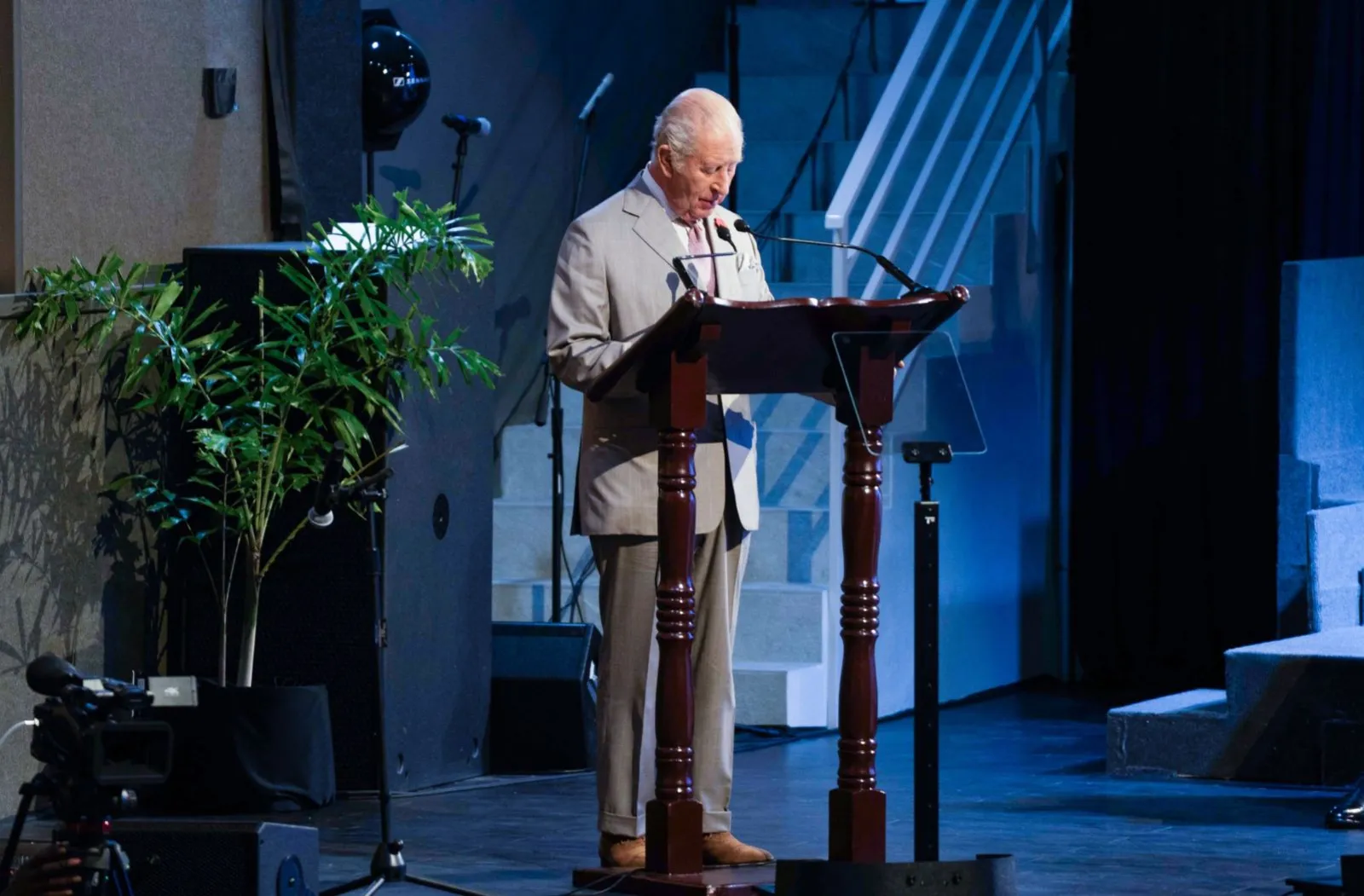
I must say it is rather sobering to think that I attended my first of these meetings almost thirty years ago. It is even more sobering to think that thirty years ago, most people had never bought anything online, many had never sent an email and connecting to the web involved a rather alarming series of screeches from a telephone line. In fact, in those days the internet was so new people referred to it as the ‘information superhighway’. I suspect that, thirty years later, many of those early users – some in this room perhaps – are still trying to remember their first passwords!
I did want to begin by thanking the Government and people of Antigua and Barbuda for their remarkable hospitality and for making us so welcome. It was a particular pleasure to be able to celebrate on Sunday the 45th anniversary of your Independence, and to honour the achievements of Antiguans and Barbudans in so many fields. For one of the smallest nations on Earth, your impact in the world is tremendous. There is great truth in the saying: “Small Island, Big Vibes”!
Ladies and Gentlemen, that in four short years we should have met in Kigali, Apia and now St John’s, shows the extraordinary span of the Commonwealth and the diversity it represents. Our histories, circumstances and perspectives may differ, but together they inspire us in our shared endeavors and strengthen us in our common cause.
Our Commonwealth family has mattered greatly to me for my whole life – and now, particularly, as King and Head of the Commonwealth– to which I have always tried to offer whatever service I can, especially in support of young people, of whom Commonwealth countries can count more than a billion, not to mention the protection of the uniquely important natural environments we each depend upon. I can only say how glad I am that The Queen shares my enthusiasm for our Commonwealth family and all that it represents, not least through The Queen’s Commonwealth Writing Competition.
None of us, of course, would be here today were it not for our history, which has shaped us in myriad ways. History is not ours to choose or to change. It is bequeathed to us in complex synthesis by forebears we can never know. Our inheritance includes both their achievements and their failures – the good they did as well as the wrongs. History can be hard to compass, viewed as it is through the prism of time, which can be both clarifying and distorting, and yet its consequences resonate with contemporary force. Our history inspires us, can appall us, yet it can always teach us. We cannot change the actions of those who came before us. We can, however, learn from the past. The transatlantic trade in enslaved persons still casts a shadow over these islands and other Members of our Commonwealth. As I have said before, that shameful chapter of history is one that fills my heart with horror and my soul with the most profound personal sorrow.
And yet history also teaches us that evil need not have the last word; that character and courage can combine to overcome the most monstrous injustice, as they did with the determination to end international trade in enslaved people, in which the Royal Navy played such a leading role. The more I have furthered my own understanding of the issues, through listening, learning and looking, the more committed I have become to finding ways for us to work in modern partnership to address the wrongs of the past with action for the future. Through improving access to education, investing in jobs and opportunities, encouraging intraCommonwealth trade, and inspiring vital climate resilience measures across the world, I have always felt that there is so much that can be done to help lift up those who struggle against hardship and disadvantage. I have always tried to play my part in doing just that. For, as any sailor navigating the seas knows, we cannot command the winds, least of all where the winds of yesterday have delivered us – but we can choose how we set our sails.
The Commonwealth of today is not merely a product of the past – it is a response to the world of today. Its vocation is more compelling than ever. In fact, in a desperately troubled world, the Commonwealth has welcomed new members who see the unique value of this organization and have chosen to be part of its future.
All around us, trust between nations is under critical strain, as international norms and systems are tested to their limits. Brutal conflict stalks our world, destroying lives and casting long shadows across the globe. Technology is transforming our societies and our economies at dizzying speed, with little certainty about where it might lead us.
As I have consistently tried to emphasize, climate change is no longer just a terrifying prospect, but a catastrophic reality which threatens our very way of life. Nature is under constant attack and critical natural systems are collapsing. And in each of our countries, for too many people, the opportunity to fulfil their own potential lies far beyond their reach.
Each of these is a challenge of the highest order. Together, they comprise the crisis of our time. The Commonwealth cannot provide all of the solutions. It does, however, offer an unparalleled opportunity to work together – across our societies and our economies, through our businesses, our institutions and our communities. It allows us to draw on the collective ingenuity of a third of humanity to address the challenges confronting us all.
This, it seems to me, is the vital essence of the Commonwealth. It lives in the people we serve. It courses through the dynamic connections between them. It flows through partnership and trade and in the solutions we find to shared challenges. It drives co-operation across borders and inspires our young people to imagine the future they can build. It provides Member States, today, here, now, with a unique opportunity: to forge common cause in the interests of our peoples.
And what unites this extraordinary and unique group of countries even more deeply is our values: of democracy and the rule of law; of respect, equal dignity and human rights; of sustainable development; of peace and security. These values have never been more important, contested as they are on so many fronts. And they guide us to action.
That is why, Secretary General, the theme of this C.H.O.G.M. – Accelerating Partnerships and Investment for a Prosperous Commonwealth – represents such a vital opportunity for us all.
To realize these opportunities, in the field of climate and Nature for example, transformative investment can drive real change, such as in renewable energy and resilient infrastructure, in sustainable, regenerative agriculture and agroforestry and food systems, in our oceans, our forests and in the natural systems upon which our economies and societies ultimately depend.
Here in the Caribbean, as in so many parts of our Commonwealth, climate change is not some distant prospect, it is an alarming reality. As we know, large Ocean States have contributed little to the causes of climate change and yet they are among those bearing the greatest cost.
If we mobilize climate finance through the private sector, and with the leveraging capacity of the public sector, we can drive investment into climate resilience. Nature herself is an essential form of capital that sustains our prosperity and wellbeing and yet we have persisted for too long to live off Nature’s capital rather than her income. To restore Nature is therefore not to choose our environment over our economy – it is to invest in the very foundations of our economy, not to mention our security.
The Secretary General has announced a series of Nature and climate proposals for consideration at this year’s Heads Meeting: a new Commonwealth Nature Initiative with funding to restore habitats; work with insurers on the proposal for a Commonwealth-backed mutual insurance mechanism to provide rapid payouts after disasters; and aspirations for a Commonwealth Net Zero Fund to provide access to credit for a renewable-energy revolution. I look forward to hearing how Commonwealth leaders, the private sector and civil society will work together on innovative proposals like these in support of all the citizens of the Commonwealth, especially in countries most vulnerable to the reality of climate change.
Another area in which, it seems to me, there is such great potential for the Commonwealth to do more, is in international trade.
Our shared legal traditions, our institutions, the long-standing networks between us, as well as the English language, give us a remarkable common advantage. So much so, that the Commonwealth Enterprise and Investment Council reminds us that it is twenty-one per cent cheaper to do business across the Commonwealth.
We can surely make far better use of this advantage – by reducing barriers to trade; improving our digital connectivity; helping small and medium-sized enterprises to find new markets; sharing the burden of insurance; and by encouraging investment across our borders.
The potential is tremendous – and it goes far beyond trade in traditional goods. There are enormous opportunities in digital services, sustainable tourism, clean energy, the creative industries, the blue economy and in the technologies of tomorrow.
In light of all these opportunities, I was so pleased to learn of the initiatives you are pursuing, Secretary General, on intra-Commonwealth trade, including those involving the private sector, which aim at realizing that potential.
Ladies and Gentlemen, today I have had time to mention just some of the ways in which our Commonwealth can use its unique advantage to deliver real and tangible change. There are, I know, many other such opportunities which you will be discussing in the days ahead.
As you do, I trust that you will take inspiration from the many remarkable leaders who came before you – the men and women from across the Commonwealth upon whose vision and determination, and unshakeable belief in the endless opportunity inherent in this unique family of nations, the modern Commonwealth was built.
Today the leadership of this unique institution is in your hands. Each of you has the opportunity to make the greatest possible difference. I pray that over these coming days you will embrace this opportunity and commit yourselves to action.
I pray that you will renew your determination to build a Commonwealth in which prosperity and Nature flourish side by side; in which investment builds resilience as well as social and economic capital; and in which trade creates opportunity from which everyone can benefit – especially those people in Member States in most need of those benefits, both economic and environmental.
Above all, Ladies and Gentlemen, I trust that each of you will recommit yourselves to a Commonwealth in which our young people can look to the future with greater confidence and purpose. So that from this remarkable family of nations, our people can draw inspiration and hope – just as I, myself, have always done.