

Commonwealth Secretary-General Shirley Botchwey's keynote speech at the H20 Annual Summit: The future of global health on 23 November 2026.
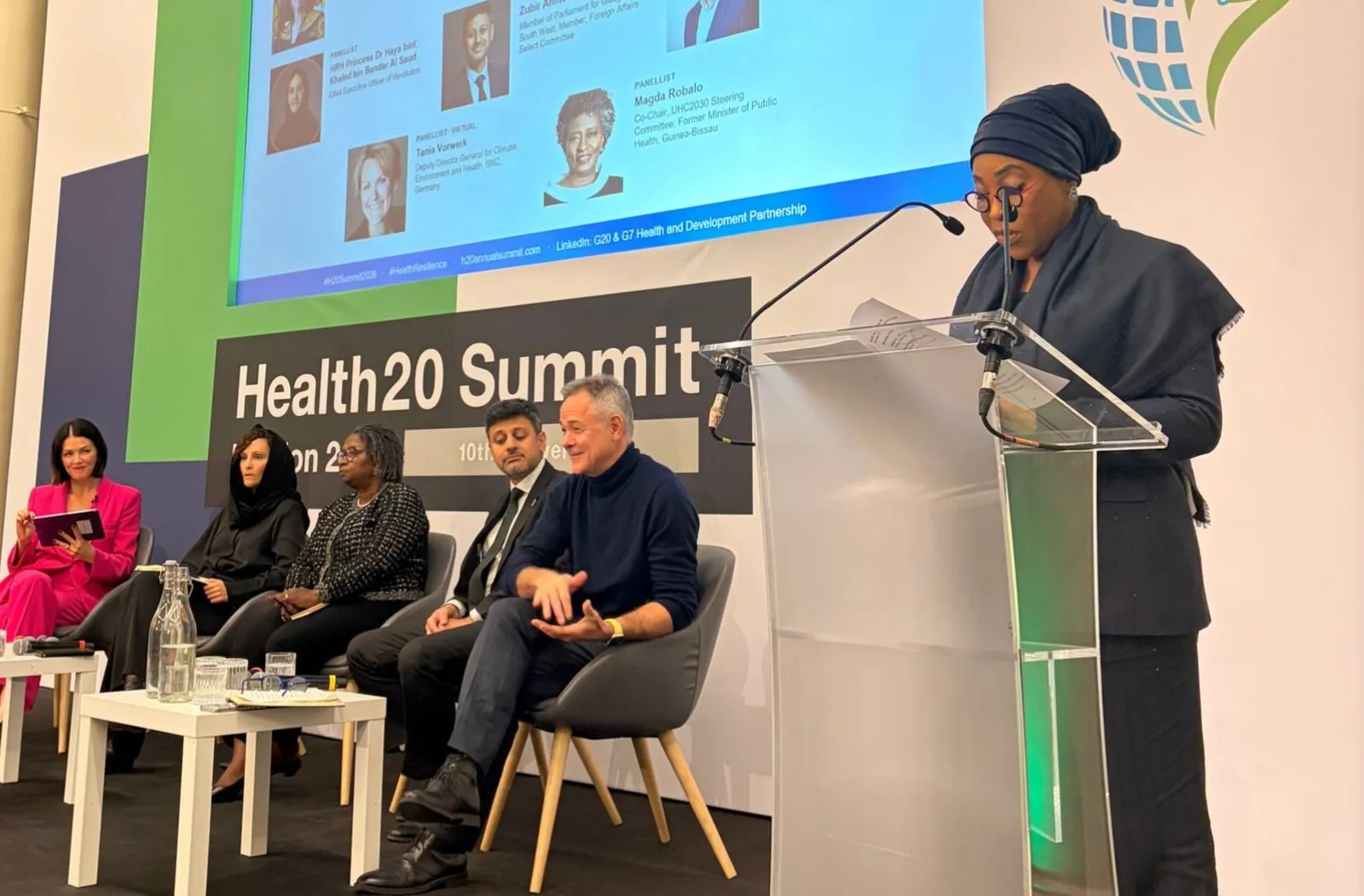
It is a pleasure to gather today under the H20 banner.
Congratulations to the G20 & G7 Health and Development Partnership, to Alan Donnelly, Hatice Beton and the whole team on ten years of pioneering work keeping health high on the agenda.
We are meeting in the right setting to reflect on the role of regional alliances in global challenges. In 1946, fifty-one nations gathered in this hall for the first meeting of the UN General Assembly. Eighty years after that first UNGA, we are living in a new era of fracture.
Our response to it should be clear-eyed and ambitious. Clear-eyed about the weaknesses of the old international system. Because, for all its achievements, it did not deliver resilience or prosperity equally; or, sustainably.
Of the Commonwealth’s 56 members, only six were represented in this hall in 1946. More recently, the system has begun to lose support even within the developed economies that built it.
Our task now is to create an ambitious new model of global co-operation, better suited to the realities of the twenty-first century. It should be inspired by the enduring values expressed in the UN and Commonwealth Charters. But its mechanics must reflect today’s multipolar world as well as the expectations of global society.
That includes fully integrating regional alliances, which play a crucial co-ordinating role, and giving voice to the small states and developing economies that have been shut out of international decision-making for too long.
Above all, it should focus on achieving tangible results which make a visible difference to the lives of the people it serves.
Success will depend on forging and strengthening effective strategic partnerships between national, regional and international bodies, to respond to the scale of the challenges we face, with ambitions that defy old assumptions of what is possible.
As a global network of 56 member countries and 2.7 billion people, the Commonwealth is big enough and broad enough to convene at a global scale, but close enough as a trusting family of nations to drive meaningful collective action.
Health provides an excellent lens to view this approach in practice.
Twelve of our accredited organisations focus on human health. They include our medical and dental associations, the Nurses and Midwives Federation and the Pharmacists Association, as well as campaign groups such as Sightsavers and Malaria No More. They are embedded in local, national and regional networks and their input informs our policy and advocacy.
As a Secretariat, we co-ordinate with our accredited organisations, member governments, regional bodies and international partners to share experience, mobilise resources and deliver practical results.
Our enhanced collaboration with the World Health Organization is a case in point. In September, I signed a renewed four-year agreement with Dr Tedros, building on our first agreement in 2022.
We combine the WHO’s technical expertise and global standards with the Commonwealth’s convening reach for coalition building and sharing of best practices as well as strategic partnerships and resource mobilisation for collective action.
The value of strategic partnership was made clear during the Commonwealth Heads of Government Meeting just a few weeks ago. Our leaders’ discussions ranged across trade, finance and investment. Health was a part of the conversation throughout, because a healthy population is an essential prerequisite to a free and prosperous society.
CHOGM provided the setting for the first Global Summit for Eye Health, convened by our host nation Antigua and Barbuda alongside the WHO, which secured major new commitments to expand access to eye care.
We also saw the launch of a new report on cancer in the Commonwealth, prepared in collaboration with The Lancet Oncology Commission. It set out how investment in cancer control can save lives and strengthen economic resilience.
Health spending is indeed an investment in the strength and prosperity of our societies and our economies. And countries need the fiscal space to sustain health services. That is why reforming the global rules on debt management, access to finance, trade and investment matters so much.
Success in that mission will require a different set of strategic partnerships – national, regional and international – to move multidimensional vulnerability from theory into practice.
Your new Health Investment Framework aims to bring health and finance ministers, investors, industry and development banks into closer alignment, and I look forward to seeing the fruits of that work.
I am hopeful that the next G20, under the United Kingdom’s presidency, will take this agenda forward for impactful action across our countries.
The G20 itself represents an evolution in multilateral engagement to include a wider range of participants, including key regional bodies like the European Union and African Union, which give its deliberations greater breadth and credibility.
I was encouraged by Prime Minister Andy Burnham’s commitment, in his speech at the Lord Mayor’s Banquet, to put debt and development finance back on the G20 agenda. Progress there will bring a health dividend if it empowers more nations to invest in the services their people need.
Success will depend on building and deploying effective strategic partnerships.
The Commonwealth is committed to playing its full role. In everyone gathered here for the H20, I know we have willing allies.
I thank you.